
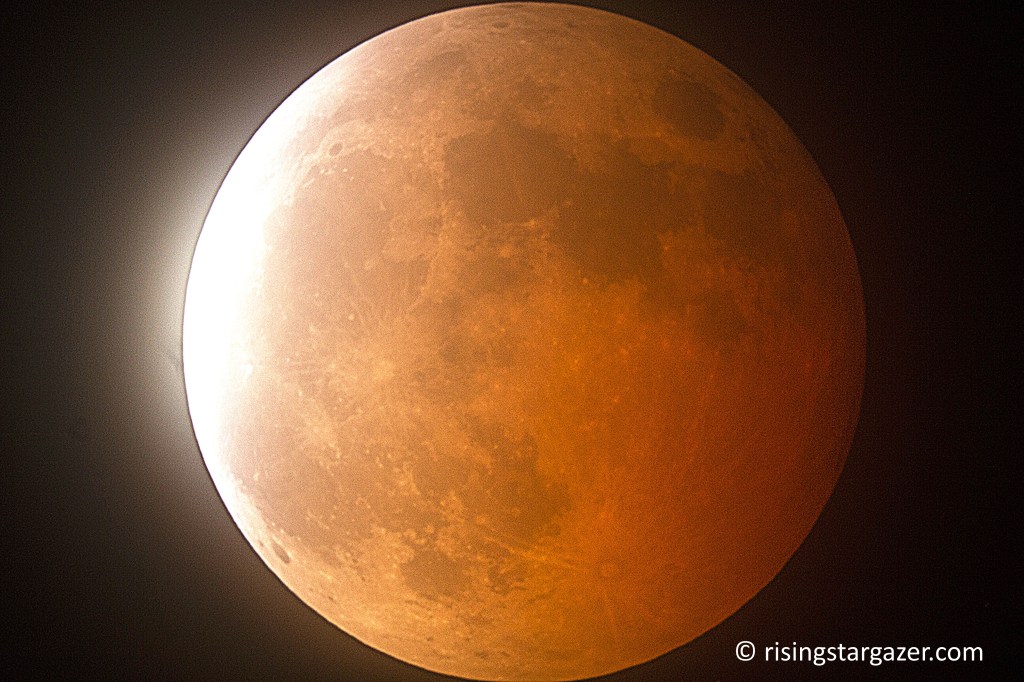
My best photo to date of a total lunar eclipse!
In the runup to the March 13/14 lunar eclipse, I had one goal: capture a picture better than the last one I got, back in 2014.
The following was taken through my 5-inch refractor, which I think was the only telescope I owned at the time:

Pretty decent for a tiny scope that doesn’t track. I had to follow the moon’s motion in the sky manually in order to get a few-second exposure.
But now, I have better gear. An 11-inch Schmidt-Cassegrain that does, in fact, track. She’s on an alt-az mount, so she can’t do super long exposures — over time, the image would rotate within the camera lens. But the moon is bright enough that I don’t need long exposures.
My telescope was up to the task. But the weather had other plans.
I rushed to get my telescope aligned to the night sky with only 30 minutes left in the total phase of the eclipse. I chose a two-star alignment: start from north, then slew to two stars, preferably opposite one another in the sky.
I usually aim at Polaris, use it to align the finder scope, then slew down to alt-index (making the scope tube horizontal while still pointing north).
But just as I slewed to Polaris, the clouds came in.
No chance of using it to align the finder. Heck, no chance of getting an exact north bearing. So I made a rough guess, then moved on to my first star: Arcturus.
Just as I was slewing, Arcturus hid behind another cloud.
Too late to switch the star, or restart the alignment — I was running out of time in the eclipse’s total phase. So I just made a rough guess as to the star’s position and moved on.
On to Procyon…which, again, slipped behind the clouds.
I made another rough guess.
And then, to my surprise…the controller displayed “Align Success!”
Peeps, I literally aligned my telescope without any stars.
Anyway, her tracking was absolutely terrible; when I punched in the moon in the controller, she was off by about half the sky. No problem there; the moon’s plenty bright enough to find manually.
By some miracle, she was still tracking well enough to keep the moon roughly in the FOV of her 11-inch tube.
That’s no small feat. With such a high-power scope, I’d expect to end up chasing the moon across the sky manually. She’d be zoomed in so far that I’d lose it easily.
Anyway, most of my photos of the total phase were hindered by the clouds; I’m impressed to have gotten a shot even this good:

The focus isn’t good enough for image enhancement to do any good. Believe me, I’ve tried. But it’s still pretty decent for a cloudy night and a scope aligned without any stars visible, don’t you think?
Anyway…of course I got the best shots of the night after the clouds moved out of the way. This was probably the best one:
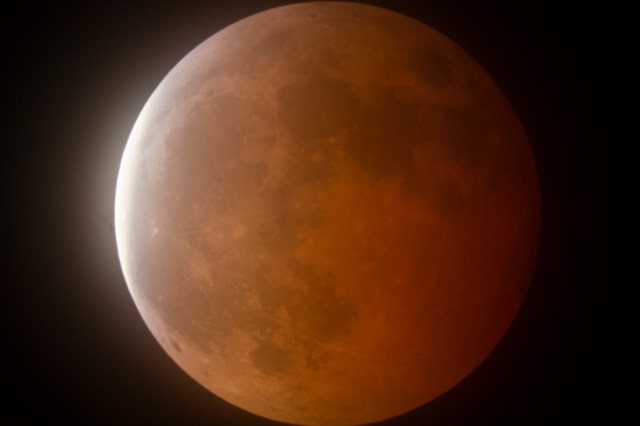
Here, you can see where the left limb of the moon peeks out from the edge of the Earth’s shadow. It’s just after the end of the total phase. But this one had decent enough focus for some image editing to do the trick…
…which is how I got the featured image 😉 It wasn’t naturally that good!
For the featured image — reproduced below — I brightened the image a bit to really bring out the red color, but that also brightens the left limb and makes it look like the Earth’s shadow has receded more than it truly has. And a little sharpening brought out the detail in the craters and maria.

For more on lunar eclipses and why they happen, check out my post over on CosmosAtYourDoorstep.com!
Specs
Telescope: 11-inch Schmidt-Cassegrain CPC
Camera: Canon Digital Rebel EOS SL1
Software: Microsoft Designer
Exposure: 5 seconds
ISO: 200
 risingstargazer.com
Well done Emma!
LikeLiked by 1 person
Thanks!
LikeLike
It sounds like you have a very similar setup to me. SOmetimes I’ve gone to align stars, done my best and it’s spat it back at me. You did well
LikeLiked by 1 person
Hey Simon, good to hear from you! Thanks!
LikeLiked by 1 person
It’s good to see you about – I Nhope all it well.
Nice Pictures 🙂
LikeLiked by 1 person
I seem to be massively late on seeing this, let alone replying – sorry! I’ll be back. Got caught up in some other projects!
LikeLiked by 1 person
I know the feeling lol
LikeLike